The state legislature has passed a budget proposal that for the first time fully funds the current form of the K-12 education funding formula. The $27.7-billion spending plan for the fiscal year that begins July 1 would pump $48-million more dollars into the state’s public schools, providing them with nearly $3.4-billion.
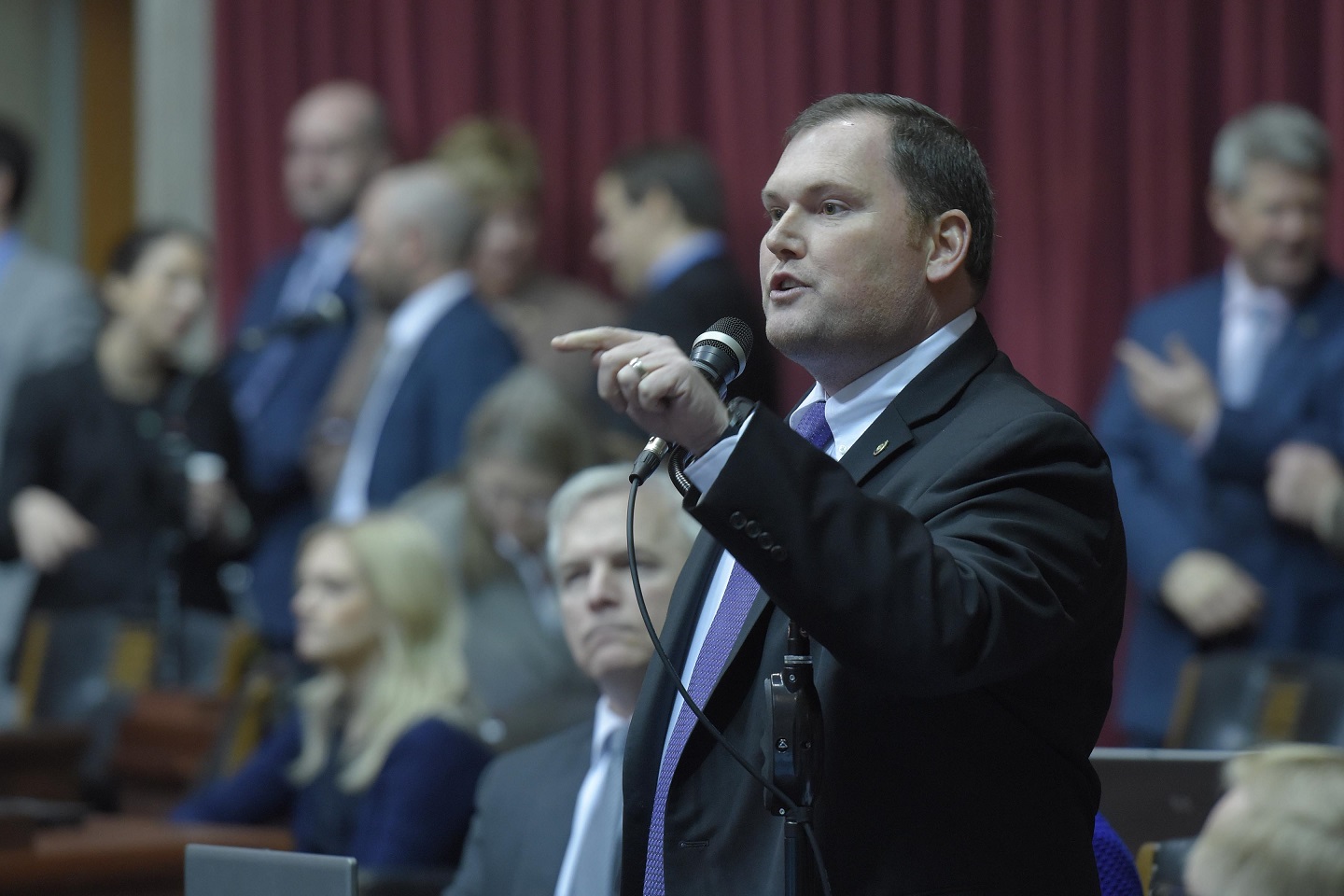
Representative Scott Fitzpatrick (photo: Tim Bommel, Missouri House Communications)
The inclusion of full funding of the formula was a personal win for House Budget Committee Chairman Scott Fitzpatrick (R-Shell Knob).
House Democrats including Representative Deb Lavender (Kirkwood) say they are pleased with the funding increase, but point out that the legislature passed last year a bill reinstating a cap on how much the formula can grow year-to-year.
The legislature’s proposal would also restore funding for school transportation, which Governor Eric Greitens (R) had proposed cutting.
The House and Senate voted to send that budget to Greitens Thursday, one day ahead of the constitutional deadline, and one day after selected House and Senate conferees finalized a compromise between each chamber’s proposals.
The legislature’s top responsibility enters its final push this week, as Friday is the constitutional deadline for it to propose a budget for the fiscal year that begins July 1.
House Budget Committee Chairman Scott Fitzpatrick (photo; Tim Bommel, Missouri House Communications)
Beginning tomorrow, selected House and Senate members will work to negotiate a compromise between each chamber’s budget proposals. Any compromise the two sides reach must then be voted on by 6 p.m. Friday to be sent to Governor Eric Greitens (R).
The House proposed that the state should for the first time fully support the formula for funding K-12 schools. Early discussions in the Senate suggested it would do otherwise, but it decided to follow suit. That was the top priority for House Budget Committee Chairman Scott Fitzpatrick (R-Shell Knob), and with both chambers agreeing on it, he says his priority now is clear.
“A balanced budget,” Fitzpatrick said.
Getting there by Friday, however, will be challenging. The difference between the two chambers’ budget proposals is somewhere beyond $100-million.
Fitzpatrick said much of that difference is in projects the Senate added when they were planning not to fully fund the K-12 education formula. When the Senate voted to instead fund the formula, it didn’t remove those projects.
Another substantial difference between the two proposals concerns “Es.” For several years, legislative budget makers have used an “E” at the end of a budget line to represent an open-ended spending limit. This was often used in places where predicting how much would be needed over the course of a fiscal year was particularly difficult, and it would allow an entity to exceed the budgeted amount if necessary. The effort to remove Es began several years ago, and the House proposed a budget that completed that removal.
The Senate restored some Es to various places in the budget. Fitzpatrick wants to remove those in the final compromise. He said their presence in the Senate’s proposal also distorts how far apart the House and Senate plans are.
Fitzpatrick said he doesn’t know how many more such examples exist throughout the budget plans.
One line of particular importance to Fitzpatrick and others in the House is the state’s legal expense fund, which has had an E on it. That line has been the focus of great legislative attention this year after the revelation that the Department of Corrections has settled millions of dollars in lawsuits in recent years in cases of employee harassment, discrimination, and retaliation.
With an E on that line – the line from which comes the money for all settlements with the state – Corrections never had to come before a legislative committee to explain what was behind the multiple, large settlements. Lawmakers say that kept them in the dark as to the environment and repeated issues in the Corrections Department.
The House’s proposal replaced that line with lines in the budgets of each state agency. That meant any future settlement would come out of the involved agency’s budget, and if it had so many that it exceeded what the legislature appropriated, it would have to explain why to lawmakers. The Senate returned the legal expense fund to being a single line in the budget. Fitzpatrick and House members strongly want to see the House’s version restored.
House and Senate conferees begin meeting Tuesday morning. Their goal is to have a compromise ready for each chamber to vote on by Friday. Failure to meet the state Constitution’s deadline could mean legislators will have to meet in a special session, after the regular session ends on May 20, to complete a budget.
The House has voted to increase transparency when lawsuits against state agencies are settled. The legislation was prompted by the revelation that millions of tax dollars were paid out over several years in settling harassment and discrimination cases against the Department of Corrections.
Representative Paul Fitzwater (R-Potosi) carried HCB 7 on the House Floor. (photo; Tim Bommel, Missouri House Communications)
House Committee Bill 7 would require the attorney general to report every month to the legislature and others about how the state’s legal expense fund – the fund from which money for settlements is taken – has been used.
Those cases against Corrections came to light late last year when an article on Pitch.com detailed several of them, and outlined how employees who complained about being harassed or discriminated against were victims of retaliation by fellow Corrections staff members.
House members said after the article came out that they were unaware of the settlements because those have been paid out of a line in the budget that has no spending limit on it. That meant departments never had to come to the legislature and justify how much their settlement agreements were costing the state.
St. Charles Republican Kathie Conway, who chairs the appropriations committee that oversees Corrections, said this bill is needed.
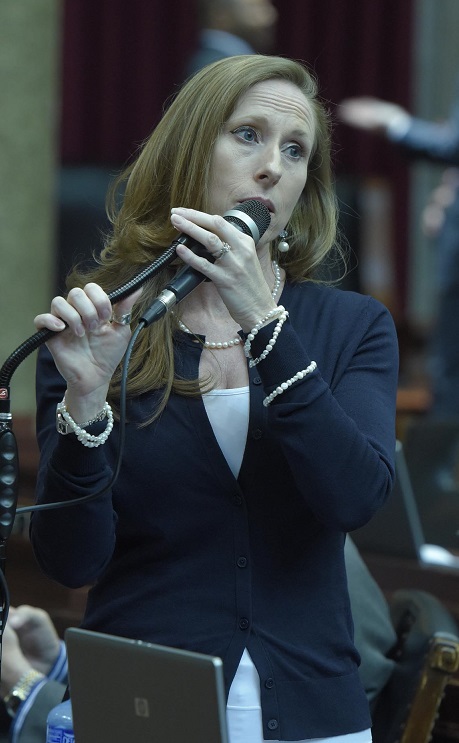
House Democrat Leader Gail McCann Beatty hopes to prevent state employees who have complained of harassment or discrimination from having to sign gag orders as part of court settlements. (photo; Tim Bommel, Missouri House Communications)
House Democrat leader Gail McCann Beatty (Kansas City) proposed that the reporting should cover all state agencies and not just the Department of Corrections. She said the reporting requirements could lead the legislature to make changes in policies or laws to address issues resulting in lawsuits in other agencies.
She hopes the legislature will go further and address the signing of gag orders by state employees who complain of harassment or discrimination, as some in the Corrections cases did under the terms of their settlements.
Missouri Attorney General Josh Hawley (R) announced in March he would begin monthly reporting on the activity of the legal expense fund. Legislators praised his decision but said HCB 7 is still needed to ensure future attorneys general will follow suit.
Hawley’s first such report comes out April 30.
HCB 7 would also require the Department of Corrections’ director to meet with the House’s committee overseeing that department twice each year to discuss issues with that department.
The House voted 150-1 to send the bill to the Senate, but only two weeks remain in the legislative session for that body to consider it.
Missouri legislative Republicans’ labor reform agenda took another step Thursday with the final passage of a bill barring project labor agreements (PLAs) for public projects.
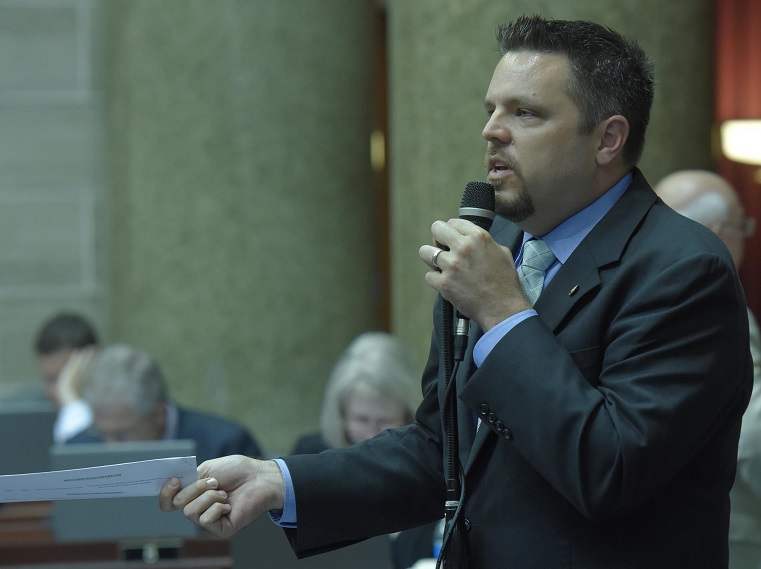
Representative Rob Vescovo began proposing a ban on project labor agreements for public projects when he was first elected to the House for the 2015 session. (photo; Tim Bommel, Missouri House Communications)
The House voted to send Senate Bill 182 to Governor Eric Greitens (R), who had called for the elimination of PLAs.
Under a PLA, a governing body requires non-union contractors to pay union dues to workers on a project. SB 182 would prohibit that, and would bar local governments from giving preferential treatment to union contractors. Governing bodies that violate the bill’s provisions would lose state funding and tax credits for two years.
Republicans said PLAs are unfair to non-union workers and contractors. Arnold representative Rob Vescovo (R) said PLAs discriminate against the largest segment of Missouri’s workforce.
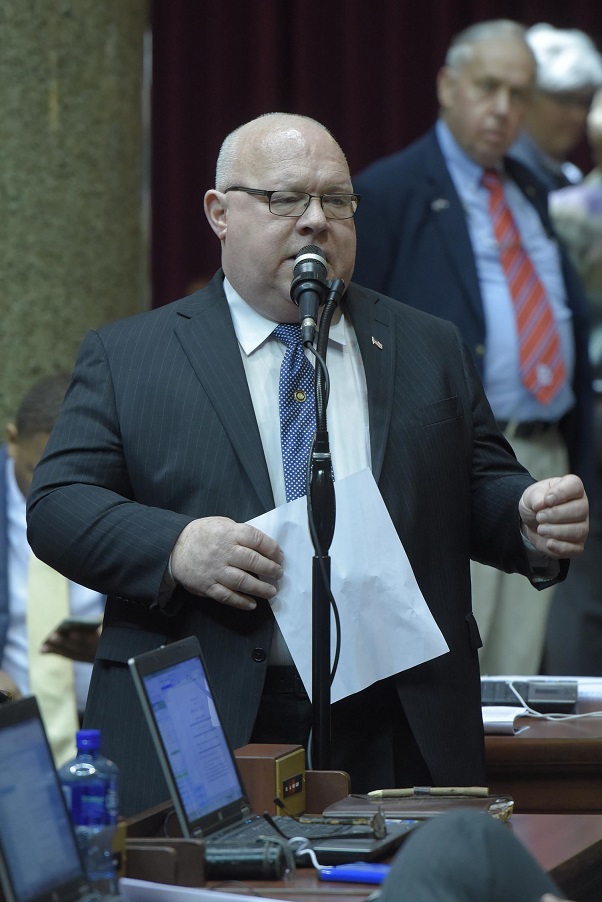
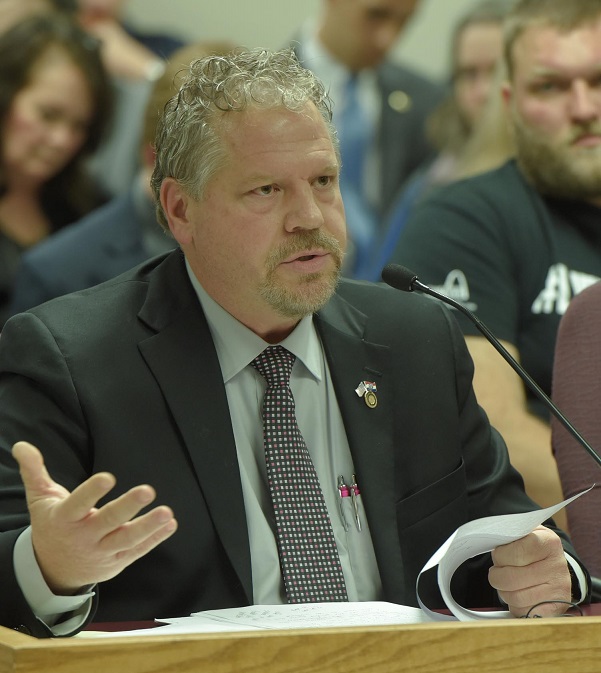
Representative Bob Burns said project labor agreements are good tools for local governments, which the legislature should not move to take away. (photo; Tim Bommel, Missouri House Communications)
Democrats called the legislation an attack on unions. Representative Bob Burns (D-St. Louis) said PLAs protect local governments by ensuring that they will have work done that is quality and completed on time by skilled workers. He said his time on a board of education in Affton provided evidence of that.
SB 182 was carried in the House by Vescovo, who began introducing such legislation as a freshman in 2015. It is expected Greitens will sign the bill into law.
The House’s passage of SB 182 follows other labor reforms it has proposed, including the passage of a right-to-work bill signed into law by Greitens earlier this year. That legislation prevents the collection of union dues or fees from workers as a condition of employment.
The state House has voted twice this session to relax Missouri’s law requiring that helmets be worn by motorcycle riders.
Representative Shane Roden offered an amendment to a Senate bill to ease Missouri’s motorcycle helmet law. (photo; Tim Bommel, Missouri House Communications)
Members voted earlier this month to pass House Bill 576, and on Tuesday voted for an amendment to Senate Bill 8, both containing the same language. They would allow riders 21 and older who have completed a motorcycle safety course or who have had their motorcycle license for at least two years to ride without a helmet if they have insurance.
Missouri legislators have for years debated easing the state’s helmet law. While both measures received favorable votes, the issue stirs passion in both proponents and opponents, and both sides of the issue are bipartisan.
The amendment to SB 8 was offered by Cedar Hill representative Shane Roden, who said he rides motorcycles himself. He said he would wear a helmet most of the time even if the law is changed, but he wants the freedom to ride without it.
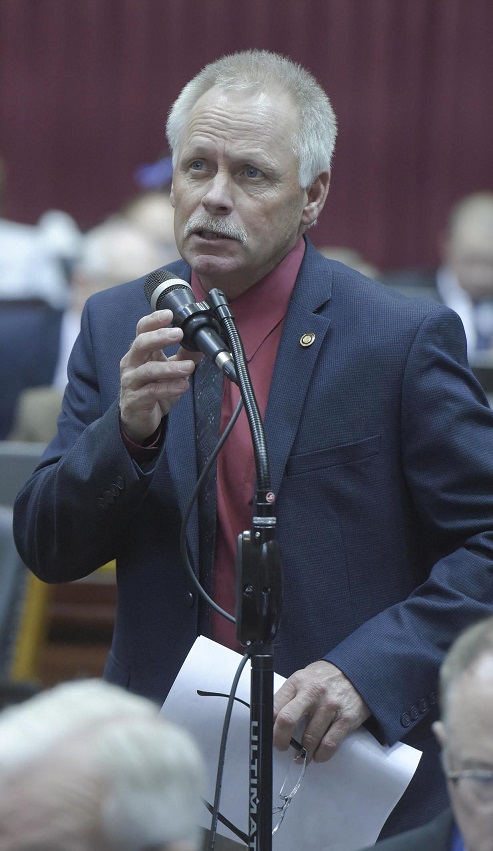
Representative Keith Frederick opposes proposals offered again this year by fellow Republicans to relax Missouri’s motorcycle helmet law. (photo; Tim Bommel, Missouri House Communications)
St. Joseph Republican Delus Johnson said as a motorcycle rider, he feels he is “grouped in” by the state’s helmet law with those who ride while intoxicated or ride recklessly.
Supporters also argue that allowing people to ride in Missouri without helmets would increase tourism. They say many riders and groups deliberately avoid the state because of its helmet law.
HB 576, sponsored by High Ridge Republican John McCaherty, is awaiting a vote by a Senate committee. SB 8 has been sent back to the Senate with several amendments that that chamber must consider.
Two state representatives have asked Missourians to remember the Holocaust on Yom HaShoah, the day Israel commemorates the six million Jews killed in that event.
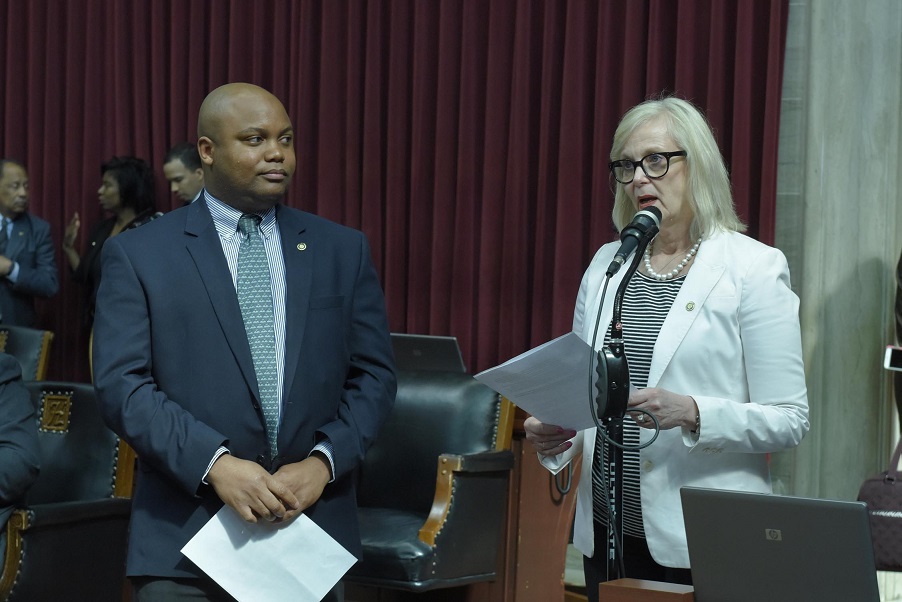
Representatives Shamed Dogan (left) and Stacey Newman speak in the Missouri House about Holocaust remembrance. (photo; Tim Bommel, Missouri House Communication)
St. Louis Democrat Stacey Newman and Ballwin Republican Shamed Dogan spoke on the House Floor on Monday, as Yom HaShoah was being observed. In Israel, the day is marked by ceremonies, the closing by law of entertainment facilities, and a two-minute moment of silence during which most people stop what they’re doing for solemn reflection. This includes motorists stopping and standing by their vehicles in the roadway.
Newman’s husband’s father, aunts, uncle, and grandmother are Holocaust survivors who escaped Nazi Germany in 1938. Many of his grandmother’s sisters, brothers-in-law, and other family members, were never accounted for.
She and Dogan, whose wife is Jewish, say they will spend the next year working together to revive the Missouri Holocaust Education and Awareness Commission Act of 2006.
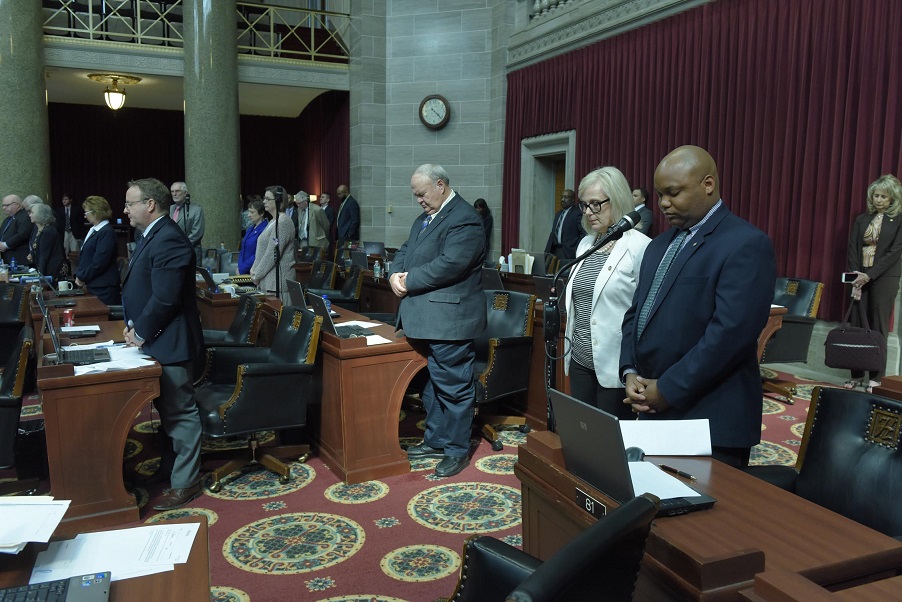
Missouri House members observe a minute of silence in remembrance of the victims, survivors, and heroes of the Holocaust. (photo; Tim Bommel, Missouri House Communications)
Dogan said he and Newman would work with the St. Louis Holocaust Museum & Learning Center and the state’s universities and public schools to keep the Act alive.
HCR 35 would ask the Defense POW/MIA Accounting Agency (DPAA) to prioritize resolution of the cases of those 15 men.
“This is a country that should honor and revere its heroes. This should not be a nation that forgets those that have given their lives in services, and we should not be a people who abandon those who have fought and died for our freedoms,” said Hurst.
Hurst shared on the House floor the story of Private First Class Paul Alfred Hasenbeck of Freeburg, who disappeared while returning from a patrol in Vietnam. His sister, Jeanie, is still looking for information on what happened to him.
St. Joseph Democrat Pat Conway is a Vietnam Veteran. He said people who fought for this country should not be left behind, and their families should not be left with questions.
Besides Hasenbeck, the Resolution lists the other 14 Missourians who fought in Vietnam and are presumed dead: First Lieutenant Steven Neil Bezold, Chief Warrant Officer 2 Donald Martin Cramer, First Lieutenant William R. Edmondson, Private First Class Dickey W. Finley, First Lieutenant Frederick William Hess Jr., Lieutenant Junior Grade Charles Weldon Marik, Major Carl D. Miller, First Lieutenant Bernard Herbert Plassmeyer, Lieutenant Colonel Dayton William Ragland, First Lieutenant Dwight G. Rickman, Captain Robert Page Rosenbach, Captain John W. Seuell, First Lieutenant George Craig Smith, and Sergeant Randolph Bothwell Suber.
The resolution has been sent to the Senate for its consideration.
The state House has asked the Senate to debate the changes it made to the House’s proposed prescription drug monitoring program (PDMP).
Representative Holly Rehder (photo; Tim Bommel, Missouri House Communications)
A PDMP aims to fight the abuse of prescription drugs by entering into a database information on people’s prescriptions to see who is getting large numbers of drugs that can be abused. Backers say the program will help identify abusers and cut back on “doctor shopping,” or going to multiple doctors to get multiple prescriptions for drugs.
The House passed House Bill 90 earlier this month that would require pharmacists to report to the database in real time by 2020, require the Department of Health and Senior Services to notify law enforcement if it believes any law or professional standard has been broken, and keep submitted prescription information confidential except when there has been a breach.
The Senate proposed several changes to the House plan. It would require that information only be kept on the database for 180 days; limit the database to opioids and benzodiazepines (the House proposed including all schedule II, III, and IV drugs); and mandate that doctors check the database before writing prescriptions for specified drugs.
The sponsor of HB 90, Sikeston Republican Holly Rehder, has been pushing for passage of a PDMP for years, driven in part by how drug abuse has affected her family. She opposes some of those proposed changes and wants to see if the House and Senate can work out differences.
She said those in the medical field she has talked to say the database won’t be effective if information is only kept on it for 180 days. They want it to be on there for at least two years.
Rehder said she would not fight the change that requires doctors to check the database before writing a prescription.
Representative Justin Hill (photo; Tim Bommel, Missouri House Communications)
The Senate also proposed letting the legislature decide after six years whether to continue the PDMP, and requiring training for database users.
Lake St. Louis Republican Justin Hill opposes Rehder’s proposal and urged the body to deny her motion. He said if Missouri is going to have a PDMP it should include the 180-day provision.
Hill would rather Missouri not have a PDMP. He argues they haven’t worked in other states except to push more people from abusing prescription drugs to heroin.
The House passed Rehder’s motion to seek a conference with the Senate, and now awaits the Senate’s answer. Fewer than four weeks remain in the legislative session for lawmakers to attempt to reach a compromise.
State lawmakers now have information from the federal government that could make clear the path forward on creating more places for veterans on a waiting list to get into the state’s veterans homes.
Representative Charlie Davis (photo; Tim Bommel, Missouri House Communications)
That waiting list has around 1800 veterans on it; about one-third of those have an immediate need for care. Legislators and state officials have in recent years considered building another state veterans home, replacing and/or expanding an existing home, or looking for options to get veterans into existing nursing homes closer to their own homes and families.
Missouri exceeds the number of veterans home beds it is allowed by the federal government before it will no longer reimburse the state for adding more. This has largely halted efforts that included attempts to pass a bond issue in the legislature to pay for a new home, at a cost now estimated to be around $60-million.
Webb City Republican Charlie Davis, in an e-mail last week to House members and staff, said the state Veterans Commission recently met with the Veterans Association about Missouri’s options for adding bed space. He said the VA confirmed it would not support the building of a new home. It would cover part of the cost to replace a home.
Davis said if a home will be replaced, it will be the home at Mexico.
A new home to replace the one at Mexico would have about 50 additional beds.
To further address the state’s waiting list, Davis said the state could utilize existing space at nursing homes throughout Missouri. The difference is that veterans don’t have to liquidate their assets to enter a veterans home, whereas a person benefitting from Medicaid support to go into a nursing home must spend down their assets to get below the income threshold for assistance.
Davis wants to seek a waiver from the federal government so that federal dollars coming to Missouri could be used for part of the cost of care for veterans in nursing homes. The remainder of that cost would come from state aid and individual veterans’ own money.
With the deadline to file new legislation for this year passed and four weeks left in the legislative session, Davis said it could be next year before the legislature can consider seeking the necessary federal waiver.
Davis, who is the chairman of the House Veterans Committee, said he is anxious to see action taken to provide homes and care for those who fought for the country.
Hannibal representative Lindell Shumake (R) has a resolution that would ask voters to approve $63-million in bonds that could go toward replacing the veterans home in Mexico. That resolution (HJR 2) has passed out of one committee and awaits a second committee’s action.
The state House has proposed that Missouri shouldn’t create any new parks until it catches up on taking care of the ones it has.
Representative Randy Pietzman (photo; Tim Bommel, Missouri House Communications)
It’s sent House Bill 698, sponsored by Representative Randy Pietzman (R-Troy), to the Senate. That would require that before any new parks are established and before any parks are expanded by more than 10-percent in acreage, the state’s current parks should be maintained, brought up-to-date, and have all maintenance work completed.
HB 698 would allow the Department of Natural Resources to accept the donation or gift of additional land, but no work could be done to it except to address public health, safety, or welfare concerns, until the other requirements of the bill are met. It would also require the Department to report annually to the General Assembly on maintenance at state parks and historic sites.
Pietzman said the bill is about making the Department of Natural Resources more accountable and more communicative with Missouri residents. He said the state has more than $200-million in state park maintenance backed up, but in recent years the Department has created and prepared new parks while letting others stay at various levels of disrepair.
The bill passed out of the House 85-62; only a few more votes than enough necessary for passage. Many, including some of Pietzman’s fellow Republicans, said it goes too far.
High Ridge Republican John McCaherty said he supports seeking greater accountability, but said prohibiting new parks until all maintenance is caught up is unrealistic.
McCaherty said the bill would tie the hands of the new administration of Governor Eric Greitens (R) in response to lawmakers’ perception of mismanagement that occurred under Greitens’ predecessor.
Representative David Wood (R-Versailles) is concerned the bill would interfere with a project to add 144-miles of the former Rock Island Railroad to the state’s trail system. He said the bill’s prohibitions would not block the state from taking that property in an anticipated donation from Ameren, but it would prevent the state from putting fencing along it.